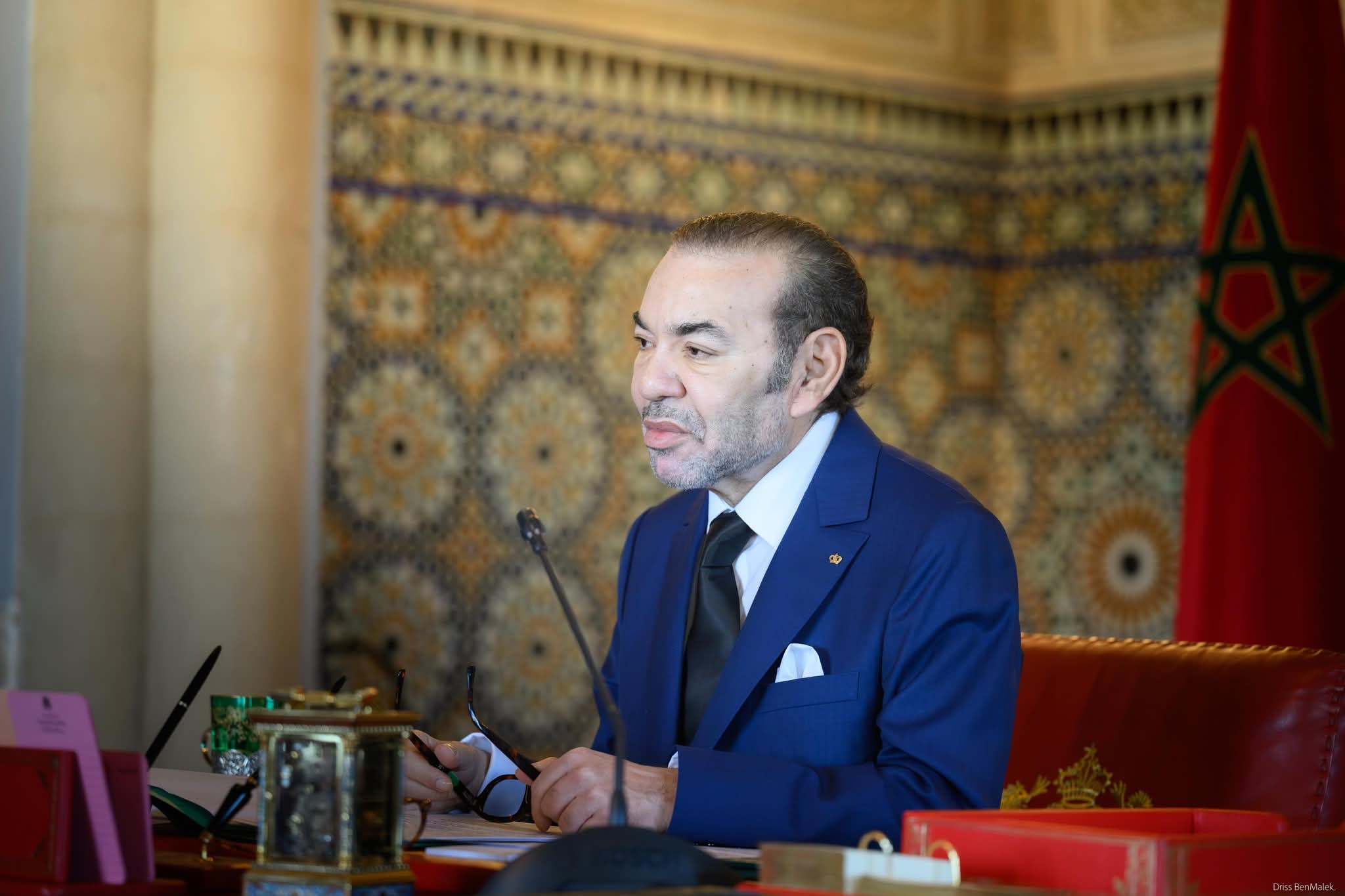
"His Majesty King Mohammed VI, may God assist Him, chaired on Thursday, April 9, 2026 (corresponding to Shawwal 21, 1447 AH), at the Royal Palace in Rabat, a Council of Ministers dedicated to the adoption of two organic draft laws, a draft decree concerning the military domain, several international agreements, and a number of appointments to senior positions.
At the opening of the Council's proceedings, His Majesty the King, may God preserve Him, inquired of the Minister of Agriculture, Fisheries, Rural Development, Water and Forests regarding the progress of the current agricultural season. The Minister confirmed that the season experienced very significant rainfall, which boosted various agricultural activities, promising favorable crop prospects.
Rainfall was recorded across all regions of the Kingdom, with an annual average reaching 520 mm, representing a 54% increase compared to the annual average of the past thirty years. This positively impacted dam storage, reaching 12.8 billion cubic meters with a filling rate of 75%. These reserves will allow Morocco to cover irrigation water needs for spring and summer crops, as well as the needs for the start of the next agricultural season.
Regarding fruit trees, Morocco recorded significant production in olives, citrus fruits, and dates, with a record olive production reaching 2 million tons (+111% compared to last year). Citrus production reached 1.9 million tons (+25%), and date production reached 160,000 tons (+55% compared to the previous season).
In execution of High Royal Instructions regarding the replenishment of the national livestock herd, the Minister confirmed that these rainfalls contributed to expanding pastures and improving livestock health.
Subsequently, the Minister of the Interior presented before His Majesty the King, may God glorify Him, an outline of the governance framework for the new generation of integrated territorial development programs. This framework relies on a new approach deriving its priorities from locally expressed needs by citizens, in line with High Royal Directives.
The overall vision of this major reform reflects the Royal Will to make improving citizens' living conditions and preserving their dignity the ultimate goal of all public policy, by enhancing territorial attractiveness, stimulating economic growth, and creating jobs. The Minister noted that the preparation of these programs was based on extensive consultations across all prefectures and provinces of the Kingdom, where territorial diagnostics were conducted.
Initial financial estimates for executing these programs over an 8-year period stand at approximately 210 billion MAD. A comprehensive plan has been established outlining governance, implementation, evaluation, and communication mechanisms:
Governance and Leadership: A bottom-up approach starting from the local level. Locally, a committee chaired by the Provincial Governor prepares and monitors projects. A committee chaired by the Regional Governor (Wali) ensures overall regional coherence. Nationally, a committee chaired by the Head of Government approves programs and tracks impact indicators.
Implementation Mechanisms: Creation of joint-stock companies (Sociétés Anonymes) with board chairs held by Regional Council Presidents, replacing Regional Project Execution Agencies (AREP) to combine public oversight with private sector efficiency.
Control and Accountability: Joint annual audits by the General Inspectorate of Finance (IGF) and the General Inspectorate of Territorial Administration (IGAT).
Communication: Launch of a dedicated digital platform to ensure complete transparency on progress and funding commitments.
Thereafter, the Council of Ministers approved the organic draft law amending and supplementing the organic law on regions, establishing a legal framework for this new generation of programs (converting AREP into joint-stock companies, refining regional powers, and strengthening financial resources).
The Council also approved the organic draft law amending and supplementing the organic law on appointments to senior positions, providing for:
Adding the "National Child Protection Agency" to the list of strategic public institutions;
Renaming the "Mohammed VI Foundation for Social Works of Judges and Justice Officials" to "Mohammed VI Foundation for Social Works of Justice Officials";
Adding the position of "General Judicial Conservators" to the list of senior positions deliberated within the Council of Government.
In the military field, His Majesty the King, Supreme Commander and Chief of General Staff of the Royal Armed Forces, approved a draft decree updating the list of military attachés stationed abroad entitled to a special monthly allowance.
To strengthen Morocco's international treaty framework, the Council approved 15 international agreements (11 bilateral agreements covering air transport, judicial matters, customs, and military cooperation; and 4 multilateral agreements, including with the WTO, the African Telecommunications Union, and the AU-NEPAD agency).
In accordance with Article 49 of the Constitution, on the proposal of the Head of Government and at the initiative of the Minister of Health and Social Protection, His Majesty the King was pleased to appoint:
Mr. Hicham Afif, Director General of the Territorial Health Group (GST) of the Casablanca-Settat region;
Mr. Brahim Lekhal, Director General of the GST of the Rabat-Salé-Kénitra region;
Mr. Abdelkrim Daoudi, Director General of the GST of the Fez-Meknes region;
Mr. Brahim El Ahmadi, Director General of the GST of the Laâyoune-Sakia El Hamra region;
Mr. Tarik El Harthi, Director General of the GST of the Souss-Massa region."