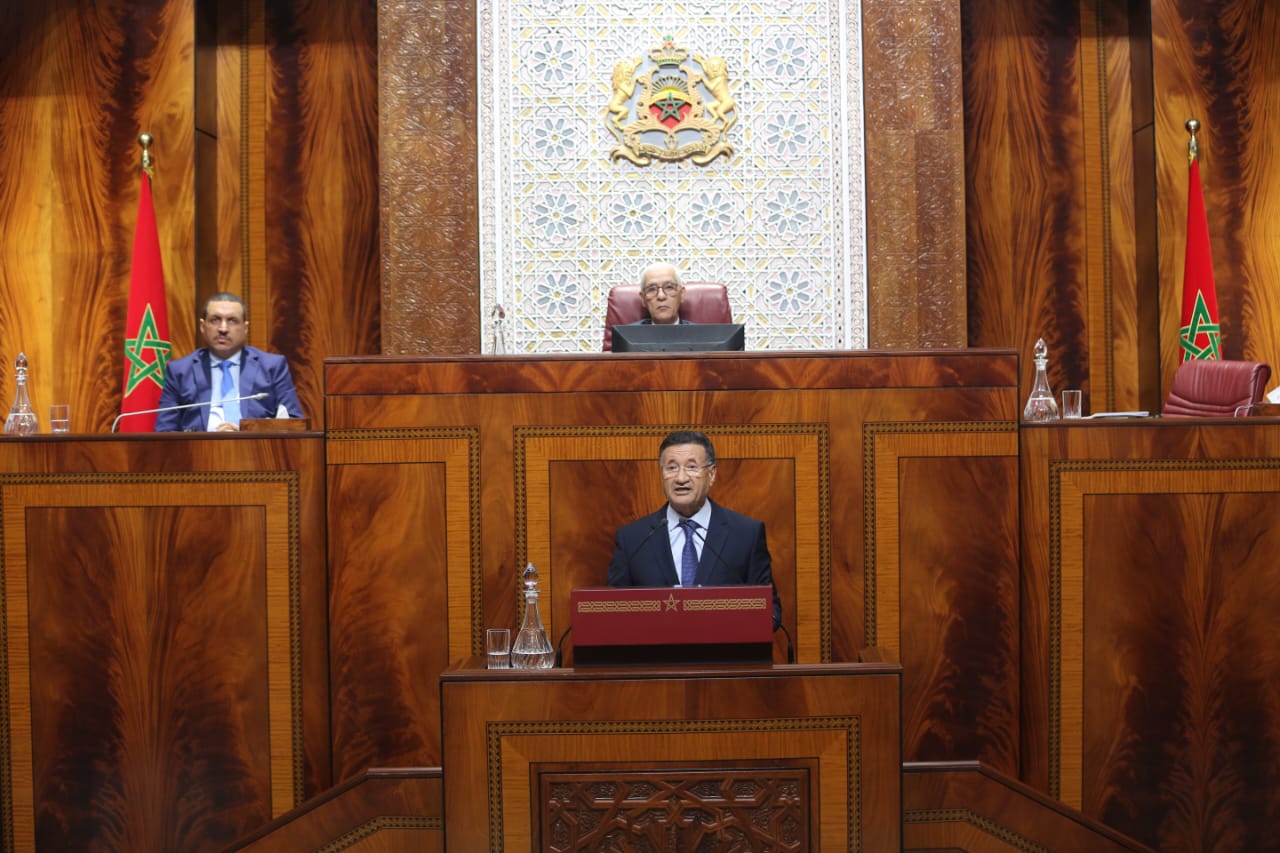
Speaking during the monthly general policy session at the House of Representatives, Mr. Chaoui Belassal, head of the Constitutional Democratic and Social Parliamentary Group, stated that Morocco’s infrastructure progress is the direct result of Royal vision, direct oversight by His Majesty King Mohammed V, innovative funding partnerships, and international trust in the Moroccan economic model.
Welcoming the Official FIFA World Cup 2030 Host Designation
Responding to the Head of Government's presentation on "The Importance of Infrastructure in Driving Economic Takeoff," Mr. Belassal began by congratulating the nation on the FIFA General Assembly’s official confirmation of Morocco, Spain, and Portugal as co-hosts of the 2030 World Cup. He described this milestone as a political and sports triumph rooted in long-term investments guided by His Majesty the King.
He noted that FIFA's selection was backed by rigorous evaluation reports confirming Morocco's operational readiness, world-class transport networks, ports, international airports, tourist capacity, public safety, and democratic stability.
Two Decades of Structural Achievements and Spatial Equity
Mr. Belassal emphasized that Morocco's current infrastructure asset was built over more than two decades along two complementary tracks:
A Regional Track: Anchoring advanced regionalization to achieve spatial and social justice across all territories.
A Strategic Long-Term Track: Transcending single legislative mandates to guarantee sustainable development and future rights for upcoming generations under the 2011 Constitution.
Addressing the Head of Government, Mr. Belassal highlighted that current and future administrations inherit a robust foundation capable of supporting sector-specific programs, improving the business environment, and generating wealth and job creation. He urged the government to extend infrastructure benefits to every province and commune across the Kingdom.
Developing Human Capital and Elevating Public Service Standards
While pointing to international reports ranking Morocco’s highways, ports, rail networks, and renewable energy infrastructure among the most advanced in Africa and the Arab world, Mr. Belassal stressed that physical infrastructure alone is insufficient without modernizing administrative management.
He called for a qualitative shift in governance through human capital development, strict compliance with administrative efficiency, and zero tolerance for corruption or poor public service. Furthermore, he urged societal awareness to eliminate incivilities in public spaces, sports venues, and transit hubs that undermine the country's international standing, expressing full confidence in Morocco's institutional capacity to overcome management challenges and fulfill its global ambitions.