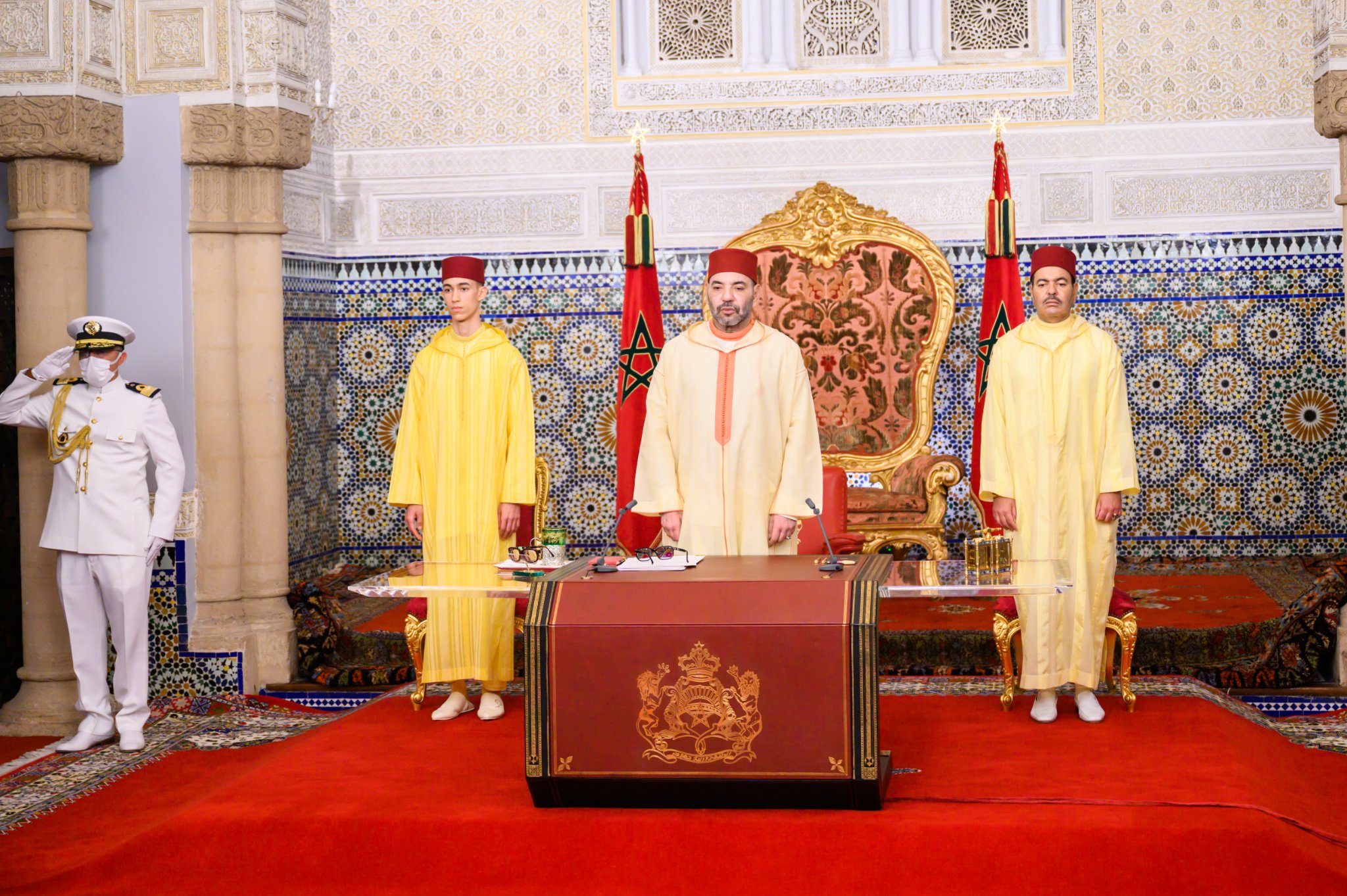
His Majesty King Mohammed VI, may God assist Him, addressed on Saturday evening a Royal Speech to His faithful people on the occasion of the 69th anniversary of the Revolution of the King and the People.
Here follows the full text of the Royal Speech:
"Praise be to God, and peace and blessings be upon the Prophet, His kith and kin.
Dear Citizens,
Today, we are commemorating the glorious epic of the Revolution of the King and the People, a watershed event on the path towards achieving independence. It also illustrates the deep bonds of affection and attachment between a King who preferred exile to yielding on the unity and sovereignty of his country, and a people who made immense sacrifices to ensure the return of their legitimate King and to regain freedom and dignity. Driven by that same spirit of sacrifice and solidarity, territorial integrity was completed with the recovery of the Kingdom's southern provinces.
Dear Citizens,
Over the last few years, we have achieved major breakthroughs at the regional and international levels in favor of the Kingdom's just and legitimate position regarding the Moroccanness of the Sahara. Thus, a number of influential states have expressed their support and positive appreciation for the Autonomy Initiative, in respect of Morocco's full sovereignty over its territory, as the only framework for resolving this artificial regional dispute. The firm position of the United States of America has been a real catalyst—a position that does not change with administrations and is not affected by circumstances. We also value the clear, responsible stance of our neighbor, Spain, which is well aware of the origins and reality of this dispute. This positive stance has paved the way for a new chapter in the Moroccan-Spanish partnership, one that is not affected by regional circumstances or internal political developments. The constructive position on the Autonomy Initiative adopted by a group of European countries, including Germany, the Netherlands, Portugal, Serbia, Hungary, Cyprus, and Romania, will contribute to opening a new page of trust-based relations, and help strengthen the qualitative partnership with these friendly countries. Parallel to this support, about thirty countries have opened consulates in the southern provinces, as a clear confirmation of their support for the Kingdom's territorial integrity and the Moroccanness of the Sahara. I should like, on this occasion, to renew my expressions of appreciation to my brothers the Kings, Emirs, and Presidents of sister Arab states, particularly Jordan, Bahrain, the United Arab Emirates, Djibouti, and the Comoros, which have opened consulates in Laayoune and Dakhla. I also wish to thank the other Arab countries that have consistently confirmed their support for the Moroccanness of the Sahara, led by the Gulf Cooperation Council States, Egypt, and Yemen. In this regard, I would also like to say how proud I am of the positions of our African brothers; approximately 40 percent of African countries, from five regional groups, have opened consulates in Laayoune and Dakhla. This dynamic also includes countries from Latin America and the Caribbean, a number of which have opened consulates in the Moroccan Sahara, while others have chosen to extend their consular jurisdiction to cover the Kingdom's southern provinces. In view of these positive developments concerning countries from all continents, I should like to send a clear message to everyone: the Sahara issue is the prism through which Morocco views the world. It is the clear, simple benchmark whereby it measures the sincerity of friendships and the effectiveness of partnerships. I therefore expect certain states, among Morocco's traditional and new partners, whose stances on the Moroccanness of the Sahara are ambiguous, to clarify their positions and reconsider their content in a manner that leaves no room for doubt.
Dear Citizens,
The cornerstone of defending the Moroccanness of the Sahara remains the unity of the domestic front and the all-out mobilization of all Moroccans—wherever they may be—to thwart the maneuvers of the enemies. I cannot fail to pay tribute here to the members of the Moroccan expatriate community, who spare no effort to defend our territorial integrity from the various platforms and positions they occupy. Morocco, thank God, has a community of about five million people, in addition to hundreds of thousands of Moroccan Jews abroad, living in all parts of the world. Moroccans of the world constitute a special case in this regard, given their strong connection to the homeland, their attachment to its sacred values, and their eagerness to serve its supreme interests, despite the problems and difficulties they face. The strength of these human ties and the pride taken in belonging to Morocco are not limited only to the first generation of immigrants; they are passed on from one generation to the next, reaching the third and fourth generations. But in return, we must constantly ask ourselves: what have we done to consolidate this bond with the homeland? Do the legislative framework and public policies take into account their specificities? Do administrative procedures meet their circumstances? Have we provided them with the necessary religious and educational support? Have we provided them with the necessary accompaniment and the right conditions for their investment projects to succeed? It is true that the State makes significant efforts to guarantee a proper welcome for Moroccans of the world. But this is not enough. Regrettably, many of them still face numerous hurdles and difficulties in taking care of their administrative affairs or launching their projects. This situation must be addressed. As for involving the diaspora in the development process—a matter I attach full importance to—I must say that Morocco needs all its children today, and all the competences and expertise residing abroad, either by working and settling in Morocco, or through various types of partnerships and contributing from their countries of residence. The Moroccan expatriate community is known to have world-class competences in various scientific, economic, political, cultural, sports, and other fields. This is a source of pride for Morocco and for all Moroccans. The time has come to provide them with the necessary accompaniment, as well as the conditions and the means for them to give their best for the benefit of their country and its development. I therefore stress the need to establish a permanent structural relationship with Moroccan competences abroad, including Moroccan Jews. I also call for the creation of a special mechanism tasked with accompanying Moroccan competences and talents abroad, and supporting their initiatives and projects. This will make it possible to identify them, communicate with them continuously, and acquaint them with their country's potential, including the development and investment dynamic. In this regard, I renew my call for Moroccan youth and project holders residing abroad to benefit from the many investment opportunities in their homeland, as well as the incentives and guarantees offered by the new Investment Charter. For their part, public institutions and the national financial and business sector are urged to open up to investors from the expatriate community by adopting effective mechanisms for incubation, support, and partnership, for the benefit of all. Finally, given the renewed aspirations of Moroccans of the world, the time has come to modernize and upgrade the institutional framework dedicated to this cherished category of citizens. The governance model of the existing institutions should be reconsidered with a view to increasing their efficiency and complementarity.
Dear Citizens,
The spirit of the immortal August 20 Revolution—with the values of sacrifice, solidarity, and loyalty to the homeland it carries—will continue to light our path and inspire successive generations, in a climate of national and territorial unity, security, and stability. This is the best tribute we can pay to the memory of the pioneers of the resistance and liberation, chiefly my revered grandfather, His Majesty King Mohammed V, and his companion in the struggle, my venerable father, His Majesty King Hassan II—may God rest their souls—as well as all the righteous martyrs of the homeland. Wassalamu alaikum warahmatullah wabarakatuh (Peace, mercy, and blessings of God be upon you)."