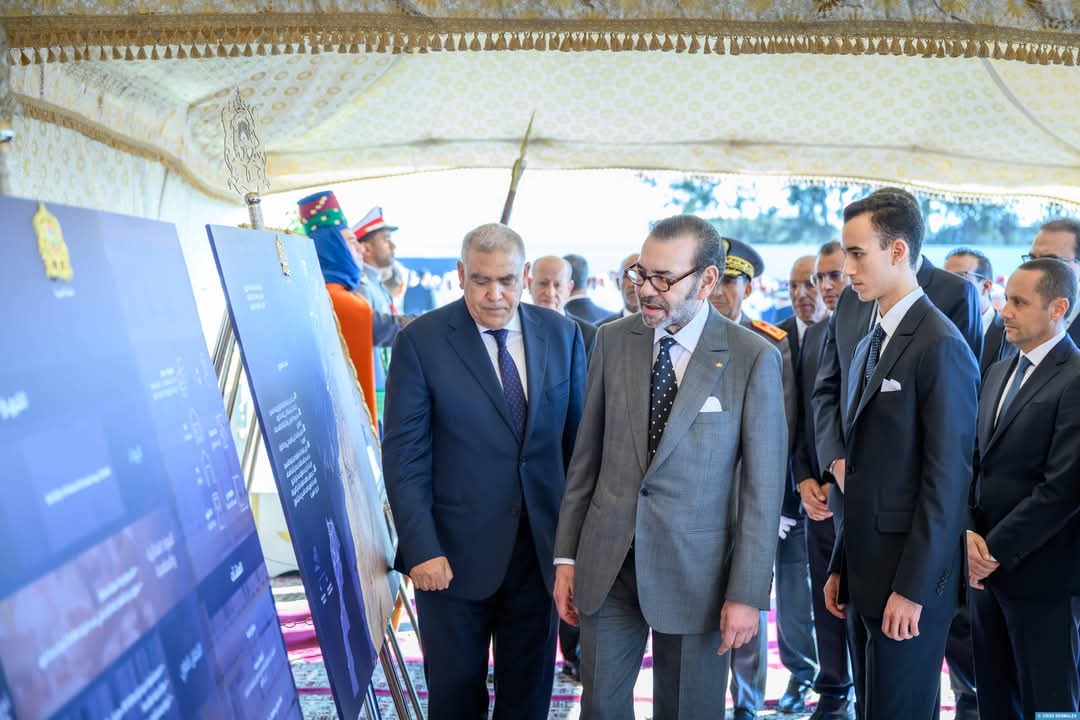
His Majesty King Mohammed VI, may God assist Him, accompanied by His Royal Highness Crown Prince Moulay El Hassan, launched on Wednesday in the commune of Ameur (Salé prefecture), the construction works of the emergency stockpile and reserves platform for the Rabat-Salé-Kénitra region. This is an embodiment of the Moroccan model of resilience and the rapid deployment of relief operations in the event of disasters.
Upon the orders of His Majesty the King, each of the Kingdom's regions will be equipped with a major platform for emergency stockpiles and reserves (tents, blankets, beds, medicines, and food supplies...), in order to face disasters (floods, earthquakes, and chemical, industrial or radiological risks) immediately.
Thus, the emergency stockpile and reserves platform for the Rabat-Salé-Kénitra region will be built on a 20-hectare plot of land within 12 months, with a total budget estimated at 287.5 million dirhams. This project particularly involves the creation of four warehouses (5,000 square meters each), two hangars for heavy equipment (2,500 square meters each), a helipad, and parking lots.
This regional platform is part of a comprehensive program, presented to His Majesty the King on this occasion, which includes the construction of 12 platforms with a total investment of 7 billion dirhams, of which 2 billion dirhams are for construction and 5 billion dirhams for the acquisition of materials and equipment.
These platforms, which will mobilize a total land area estimated at 240 hectares, will host 36 warehouses, distributed according to the demographic density of each region and potential risks.
For the six regions of Casablanca-Settat, Rabat-Salé-Kénitra, Marrakech-Safi, Fez-Meknes, Tangier-Tetouan-Al Hoceima, and Souss-Massa, the platforms will consist of four warehouses, with a total area of 20,000 square meters each. Meanwhile, the platforms for the six other regions, namely: the Oriental, Beni Mellal-Khenifra, Draa-Tafilalet, Guelmim-Oued Noun, Laayoune-Sakia El Hamra, and Dakhla-Oued Ed-Dahab, will contain two warehouses with a total area of 10,000 square meters each.
The materials and equipment to be stored in these platforms aim to ensure a rapid response for the benefit of affected populations in the event of a disaster, and to guarantee urgent and reasonable coverage of rescue, assistance, and care needs, in accordance with the proactive vision of His Majesty the King.
In this regard, these materials and equipment, intended for immediate deployment following the potential occurrence of a natural disaster, will cover the following main categories:
Shelter: by providing 200,000 multi-service tents and related equipment (camp beds, regular beds, blankets...);
Feeding the affected populations: through mobile bakeries and kitchens, as well as ready-to-eat meals for affected families;
Covering the affected populations' needs for drinking water and electricity: by providing equipment for water purification and drinking water treatment, and electrical power production using towable generators;
Developing rescue and intervention capabilities in the event of disasters: This particularly involves preparing stockpiles of necessary equipment to deal with floods, rescue operations in cases of earthquakes, landslides, and mudslides, and combating chemical, industrial, or radiological risks;
Providing healthcare for the affected populations: by providing, in a first phase, 6 field hospitals with 50 beds each, and 6 other hospitals in a second phase, comprising emergency operation units and medical service units in various specialties. This mobile hospital infrastructure will be complemented by setting up advanced medical posts in affected sites for triage and first aid. In this context, it also involves making medicine stockpiles available for the immediate needs of affected persons.
The storage of food supplies and medicines will be managed by specialized teams according to highly strict rules, in a manner that meets the prevailing standards in this field.
The establishment of these platforms aims to develop the national emergency infrastructure, improve the comprehensive crisis intervention system, ensure greater speed in providing relief and assistance to those affected, and enhance Morocco's resilience in facing various crises.
The comprehensive program for establishing the regional emergency stockpile and reserves platforms will also enable the availability of strategic stockpiles capable of responding to three times the needs that were met following the Al Haouz earthquake, in addition to developing a national ecosystem for the production of equipment and materials necessary for the immediate launch of relief operations in the event of disasters.
These regional platforms, whose locations were chosen according to safety criteria, have been designed based on an in-depth analysis of the needs of each of the Kingdom's regions, taking into account the inherent risks, supported by a study of best practices and international standards in this field.