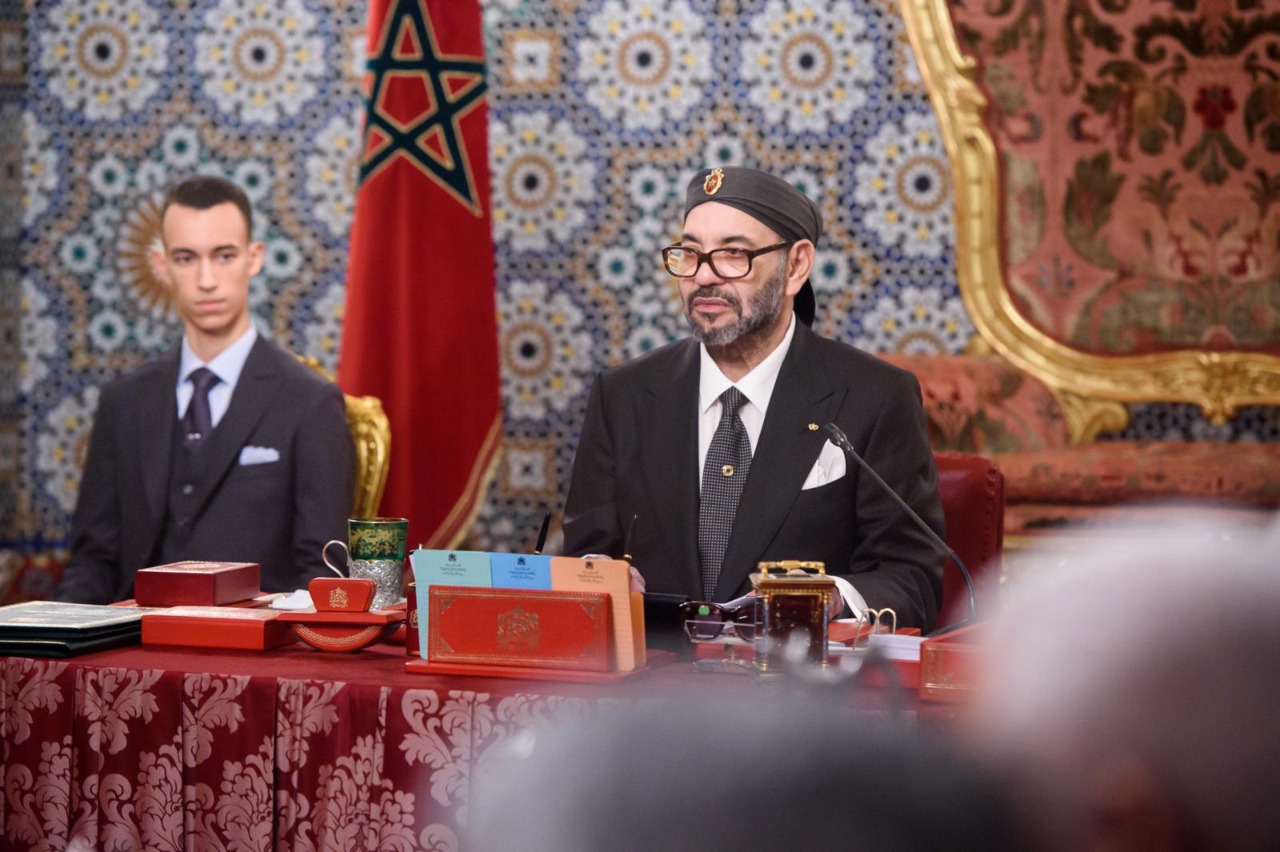
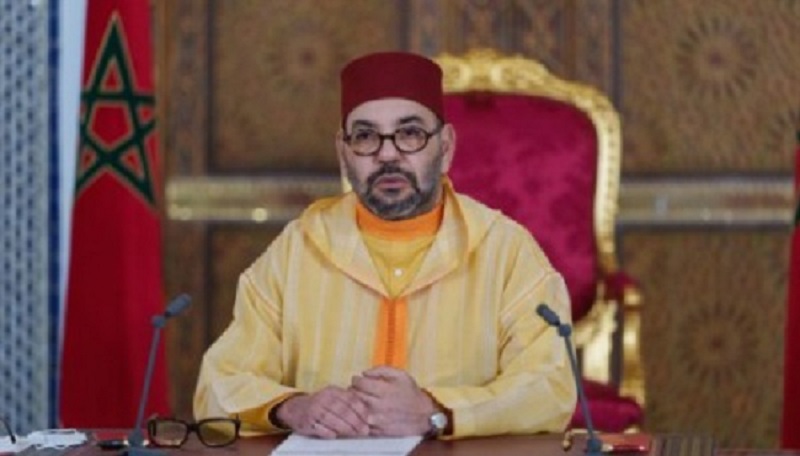
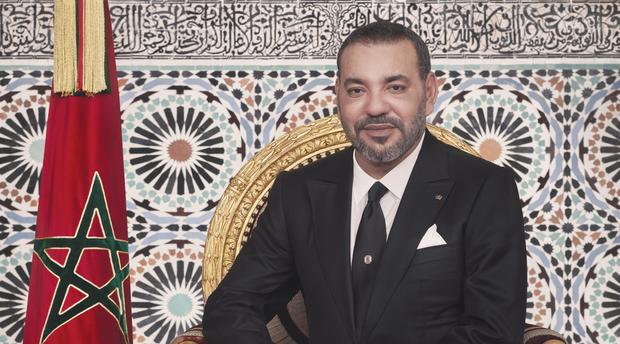
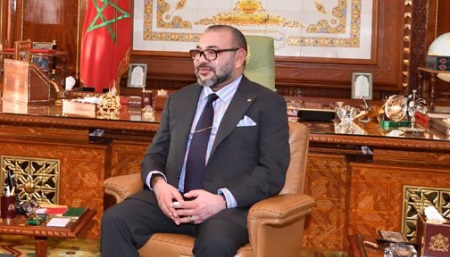
His Majesty King Mohammed VI, may God assist Him, accompanied by Crown Prince His Royal Highness Prince Moulay El Hassan, chaired on Tuesday, October 18, 2022, corresponding to Rabi' I 21, 1444 AH, at the Royal Palace in Rabat, a Council of Ministers devoted to discussing the general orientations of the Finance Bill for the year 2023, and approving a draft Dahir (Royal Decree), three draft organic laws, three draft decrees, in addition to a number of international agreements.
At the beginning of the Council's proceedings, and in accordance with the provisions of Article 49 of the Constitution, the Minister of Economy and Finance presented an overview before His Majesty the King regarding the broad lines of the 2023 Finance Bill.
The Minister affirmed that this project was prepared in an unstable international context, marked by inflation and disruptions in production chains.
The general orientations of the 2023 Finance Bill are based on four main pillars:
First: Consolidating the foundations of the social state: through the implementation of the various components of the Royal project to generalize social protection, especially completing the generalization of compulsory health coverage for all social categories, and the gradual generalization of family allowances. This will be done through a new approach for the direct targeting of vulnerable groups, based on the implementation of the Unified Social Registry and accelerating its generalization across all regions of the Kingdom. In parallel, the upgrading of the national health system will be continued by increasing the funds allocated to the health and social protection sector. The roadmap relating to the reform of the education and training system will also be activated, alongside encouraging women's full participation in all economic fields, safeguarding their rights, and working on the integration of persons with disabilities. Considering the importance of facilitating access to housing and ensuring conditions for a dignified life, direct state support in this area has been established for the targeted groups.
Second: Reviving the national economy by supporting investment: through the implementation of the new Investment Charter and executing the commitments made under industrial investment projects. In implementation of the High Royal Instructions, the Mohammed VI Fund for Investment will be operationalized, and a new dynamic will be given to public investment, directing it towards infrastructure projects and ambitious sectoral strategies, thereby enhancing the competitiveness of the national product and strengthening national sovereignty on the food, health, and energy levels. Considering the role of the tax system in overcoming current economic challenges and achieving the desired goals in economic recovery, the provisions of the framework law on tax reform will be implemented. This provides visibility for economic actors through a comprehensive reform of corporate tax, as well as the banking and insurance sectors, in parallel with alleviating the tax burden on middle-class employees and retirees.
Third: Enshrining spatial justice: by continuing the implementation of advanced regionalization and the program for reducing spatial and social disparities. Efforts will also be made to accelerate administration reform by simplifying procedures and launching a new national strategy for digital transition, in addition to continuing efforts in administrative deconcentration and the use of the Amazigh language in various areas of national life.
Fourth: Restoring financial margins to ensure the sustainability of reforms: by mobilizing all available financial resources through rigorous tax collection and adopting innovative financing mechanisms, ensuring the rationalization of administration operating expenses, implementing the reform of public procurement and the organic law of the finance law, and re-evaluating the public portfolio and improving its performance.
The Minister indicated that this project is based on assumptions setting the growth rate at 4%, inflation at around 2%, and the budget deficit at around 4.5% of GDP.
After the Council of Ministers approved the general orientations of the 2023 Finance Bill, a draft Dahir relating to the airworthiness and safety of military aircraft was approved. This project, prepared in execution of the High Instructions of His Majesty the King, Supreme Commander and Chief of General Staff of the Royal Armed Forces, aims to establish a specific system for the airworthiness of military aircraft to ensure their compliance with aviation safety rules, and to create a specific regulatory authority within the General Staff of the Royal Armed Forces, by decision of His Majesty the King.
Following this, the Council of Ministers approved two draft organic laws amending and supplementing the organic laws relating to the Supreme Council of the Judicial Power and the statute of judges. The project relating to the Supreme Council of the Judicial Power aims, in particular, to review the structures of the Council at the level of the General Secretariat and administrative organization, adapt the legal status of the joint body for coordination in judicial administration, moralize the election of judges' representatives, and strengthen the Council's role in overseeing the values of integrity and uprightness within the judiciary. The project relating to the statute of judges aims to review the ranks of judges, ensure efficient management of the selection procedure for judicial officials, and activate the Council's role in supervising judges and evaluating their career paths and judicial performance.
The Council of Ministers also approved a draft organic law amending and supplementing the organic law relating to appointments to senior positions. This project aims to:
Add the "Moroccan Copyright and Related Rights Office" and the "Joint Foundation for the Promotion of Social Works for Employees and Agents of Public Administrations" to the list of public institutions whose officials' appointments are deliberated in the Government Council.
Replace the name "General Council of Equipment, Transport, Logistics and Water," included in the list of senior positions in public administrations deliberated in the Government Council, with the name "General Council of Equipment."
Embodying the special care that His Majesty the King, Supreme Commander and Chief of General Staff of the Royal Armed Forces, constantly shows to the members of these forces, His Majesty approved two draft decrees relating to the military field. This concerns a draft decree amending and supplementing the Dahir setting the salaries of military personnel of the Royal Armed Forces, aimed at improving the financial and social situation of military personnel working in the military health field. The second draft decree relates to the application of the law on trust services for electronic transactions and seeks to accompany the digital transformation as an important priority project.
The Council of Ministers also approved a draft decree amending the decree setting the conditions for granting family allowances to civil servants, military personnel, and employees of the State, municipalities, and public institutions. This project, which comes in implementation of the government's commitments in the agreement signed with the most representative trade unions within the framework of social dialogue, aims to increase the monthly amount of family allowances benefiting civil and military personnel and employees of public institutions for their fourth, fifth, and sixth children.
Within the framework of implementing the sound Royal vision for the Kingdom's foreign policy regarding the expansion and diversification of partnership networks and establishing fruitful cooperation relations with various geographical areas, the Council of Ministers approved eight international agreements, three of which are bilateral and five multilateral. At the bilateral level, these agreements concern partners belonging to the African and Arab regions and involve the promotion and protection of investments, air services, and cooperation in the peaceful uses of nuclear energy. The multilateral agreements cover various fields, including ensuring the protection of workers' claims in the event of their employer's insolvency, the constitution of the African Civil Aviation Commission, the African Energy Commission, regulating passenger transport on roads between and across Arab countries, and the headquarters agreement with the Agence Universitaire de la Francophonie (AUF).
At the end of the Council's proceedings, and in accordance with the provisions of Article 49 of the Constitution, upon a proposal by the Head of Government and at the initiative of the Minister of Economy and Finance, His Majesty the King, may God glorify Him, kindly appointed Mr. Mohamed Benchaaboun as Director General of the Mohammed VI Fund for Investment.