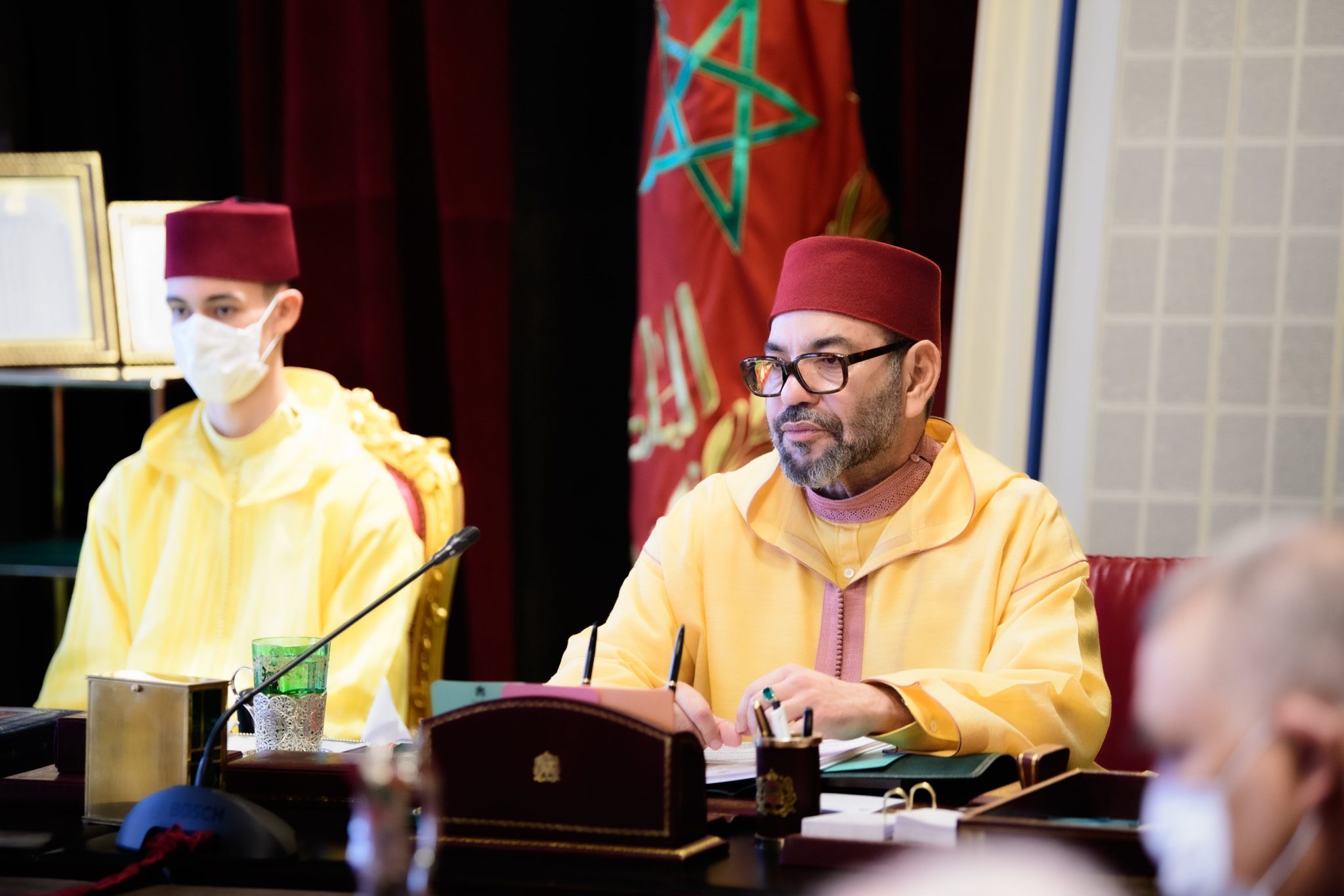
His Majesty King Mohammed VI, may God assist Him, accompanied by HRH Crown Prince Moulay El Hassan, chaired on Wednesday at the Royal Palace in Rabat, a Council of Ministers devoted to the adoption of two draft framework laws, a draft law, two draft decrees, and a set of international agreements.
Here is the text of the communiqué read by the Spokesperson of the Royal Palace, Mr. Abdelhak El Merini, on this occasion:
"His Majesty King Mohammed VI, may God assist Him, accompanied by HRH Crown Prince Moulay El Hassan, chaired on Wednesday, 13 Dhu al-Hijjah 1443 H, corresponding to July 13, 2022, at the Royal Palace in Rabat, a Council of Ministers devoted to the adoption of two draft framework laws, a draft law, two draft decrees, and a set of international agreements.
At the beginning of the Council's proceedings, the Minister of Health and Social Protection presented before His Majesty the King, may God glorify Him, a presentation on the draft framework law relating to the National Health System, which was prepared in execution of the High Royal Instructions to rethink the health system so that it is up to the standard of the universalization of social protection ordered by His Majesty the King.
This structuring reform project rests on four main pillars:
The first pillar: Adopting good governance aimed at strengthening regulation mechanisms, controlling the action of actors, and consolidating hospital governance and territorial planning of the health offering, at all levels:
Strategically: through the creation of a Higher Health Authority, a Medicines and Health Products Agency, and a Blood and Blood Derivatives Agency.
Centrally: through the review of the missions, functions, and structure of the central administration.
Territorially: through the creation of Territorial Health Groups, which will be mainly responsible for preparing and implementing the regional medical program, and strengthening cooperation and partnership mechanisms between the public and private sectors.
The second pillar: Valuing human resources, particularly through the creation of a public health function law to motivate human capital in the public sector, reducing the current shortage in human resources, reforming the training system, as well as opening up to foreign medical competencies, and encouraging Moroccan medical executives residing abroad to return to their homeland.
The third pillar: Upgrading the health offering to meet the expectations of Moroccans regarding facilitated access to medical services, improving their quality, and ensuring an equitable distribution of hospital services across the national territory. This will be achieved by reforming primary healthcare establishments, upgrading hospitals, establishing a compulsory care pathway, and creating an accreditation system for health establishments.
The fourth pillar: Digitalizing the health system through the creation of an integrated information system to collect, process, and use all essential data related to the health system.
Following this, the Minister Delegate to the Head of Government in charge of Investment, Convergence, and the Evaluation of Public Policies delivered a presentation on the draft framework law acting as an Investment Charter, noting that this project comes in execution of the High Royal Directives aimed at providing Morocco with a "competitive investment charter."
This project aims to increase the impact of investment, particularly regarding the creation of stable jobs and reducing disparities between provinces and prefectures in attracting investments. It also seeks to direct investment toward high added-value productive sectors, achieve sustainable development, enhance the Kingdom's attractiveness, make it a continental and international hub for foreign direct investment (FDI), improve the business climate, facilitate the investment process, and increase the contribution of national and foreign private investment.
To achieve these objectives, a core support mechanism has been established for strategic projects, alongside three specific mechanisms to support small and medium-sized enterprises (SMEs), and Moroccan companies seeking to develop their capacities internationally.
The Minister stressed that the government has also taken a series of parallel measures aimed at accelerating projects related to simplifying and digitalizing procedures, facilitating access to land, improving governance, and strengthening the involvement of the private and banking sectors in the field of investment.
The Council of Ministers adopted these two projects: the draft framework law on the National Health System and the draft framework law acting as an Investment Charter.
It also adopted a draft law and two draft decrees, respectively:
A draft law on firearms, their parts, components, accessories, and ammunition: It aims to modernize and improve the legal arsenal relating to civilian-use firearms to keep pace with social and technological transformations, by creating an electronic national register of firearms, as well as organizing and controlling operations related to the trafficking and possession of various types of weapons. It also includes provisions governing the entry and exit of these weapons into and out of the national territory.
A draft decree on the control of the export and import of dual-use civil and military goods and related services: It aims to define the administration's representatives within the special committee for these goods, the modalities for issuing, modifying, suspending, and withdrawing export and import licenses, as well as the conditions and modalities for appointing agents authorized to search for violations of the provisions of the law concerning these goods.
A draft decree supplementing the decree on the status of military attachés, their assistants, and other military personnel assigned to work with them: It aims to create the post of military attaché at the Kingdom's embassy in India and the Kingdom's embassy in Turkey.
Within the framework of strengthening the cooperation and partnership networks tying Morocco to a number of brotherly and friendly countries, and diversifying their fields, the Council of Ministers adopted 16 international agreements, including 9 bilateral and 7 multilateral agreements.
The bilateral agreements concern the African space in the fields of transport and logistics, as well as the promotion and protection of investments; the Arab Gulf and Middle East space in the fields of economic, commercial, and tourism cooperation, and business events; the European space in the fields of education and Moroccan workers abroad; in addition to the Asian space in the field of air services.
As for the multilateral agreements, three of them relate to establishing the headquarters of the Pan-African Youth Union in Morocco, recognizing higher education diplomas and degrees in African countries, and creating an African technical cooperation program.
The remaining agreements concern the accession to the Council of Europe Convention on the Manipulation of Sports Competitions, the establishment of the International Organization for Marine Aids to Navigation, the international recovery of child support and other forms of family maintenance, and the protection of workers against occupational hazards.
In accordance with the provisions of Article 49 of the Constitution and upon the proposal of the Head of Government: – And upon the initiative of the Minister of Economy and Finance, His Majesty the King was pleased to appoint:
Mr. Khalid Safir as Director General of the Caisse de Dépôt et de Gestion (CDG).
Mr. Abdellatif Zaghnoun as Director General of the National Agency for the Strategic Management of State Contributions and Performance Monitoring of Public Establishments and Enterprises. – Upon the initiative of the Minister of Agriculture, Maritime Fisheries, Rural Development, and Water and Forests, His Majesty the King appointed:
Mr. Noureddine Boutayeb as Chairman of the Directoire of Crédit Agricole du Maroc (CAM).
Mr. Abderrahim Houmy as Director General of the National Agency for Water and Forests. – Upon the initiative of the Minister Delegate to the Head of Government in charge of Investment, Convergence, and the Evaluation of Public Policies, His Majesty the King appointed Mr. Ali Seddiki as Director General of the Moroccan Agency for Investment and Export Development (AMDIE).
At the end of the Council's proceedings, the Minister of Interior presented before His Majesty the King, may God preserve Him, a presentation relating to the measures drafted in execution of the High Royal Instructions concerning the organization of the Moroccan Jewish community.
These measures derive their spirit from the supreme responsibility assumed by His Majesty the King, Commander of the Faithful, as the guarantor of the free exercise of worship for all Moroccans across all religious beliefs, and to consecrate the Hebrew tributary as a component of the rich, multi-faceted Moroccan culture.
The framework submitted for the High Appreciation of His Majesty the King, which was elaborated following extensive consultations with representatives of the Jewish community and affiliated personalities, includes the following bodies:
First: The National Council of the Moroccan Jewish Community: It is responsible for managing the affairs of the community and safeguarding the heritage, cultural, and religious influence of Judaism and its authentic Moroccan values. Regional committees will emerge from the Council to manage the daily issues and affairs of the community's members.
Second: The Committee of Moroccan Jews Abroad: It works to strengthen the ties connecting Moroccan Jews residing abroad to their country of origin, enhance their religious and cultural influence, and defend the Kingdom's supreme interests.
Third: The Foundation of Moroccan Judaism: It is tasked with promoting and taking care of the Moroccan Jewish intangible heritage, safeguarding its traditions, and preserving its specificities."